Da Luen
T100BPM Process Management
T100 group management with BPM e-approval takes cross-border processes fully paperless.
- Approval time 15 min → 2 min
- Manual workload down 80%
“We take orders in Taiwan, produce in Thailand and consolidate at group level — what I fear most is three sets of books that won’t reconcile at month-end.”
Digiwin T100 is a group-level ERP built for mid-to-large manufacturing groups with multinational footprints: multi-country accounting standards, multi-currency, multi-language and local filing support all in one, so a single system supports group operations from Taiwan headquarters to plants in Vietnam, Thailand and Malaysia.
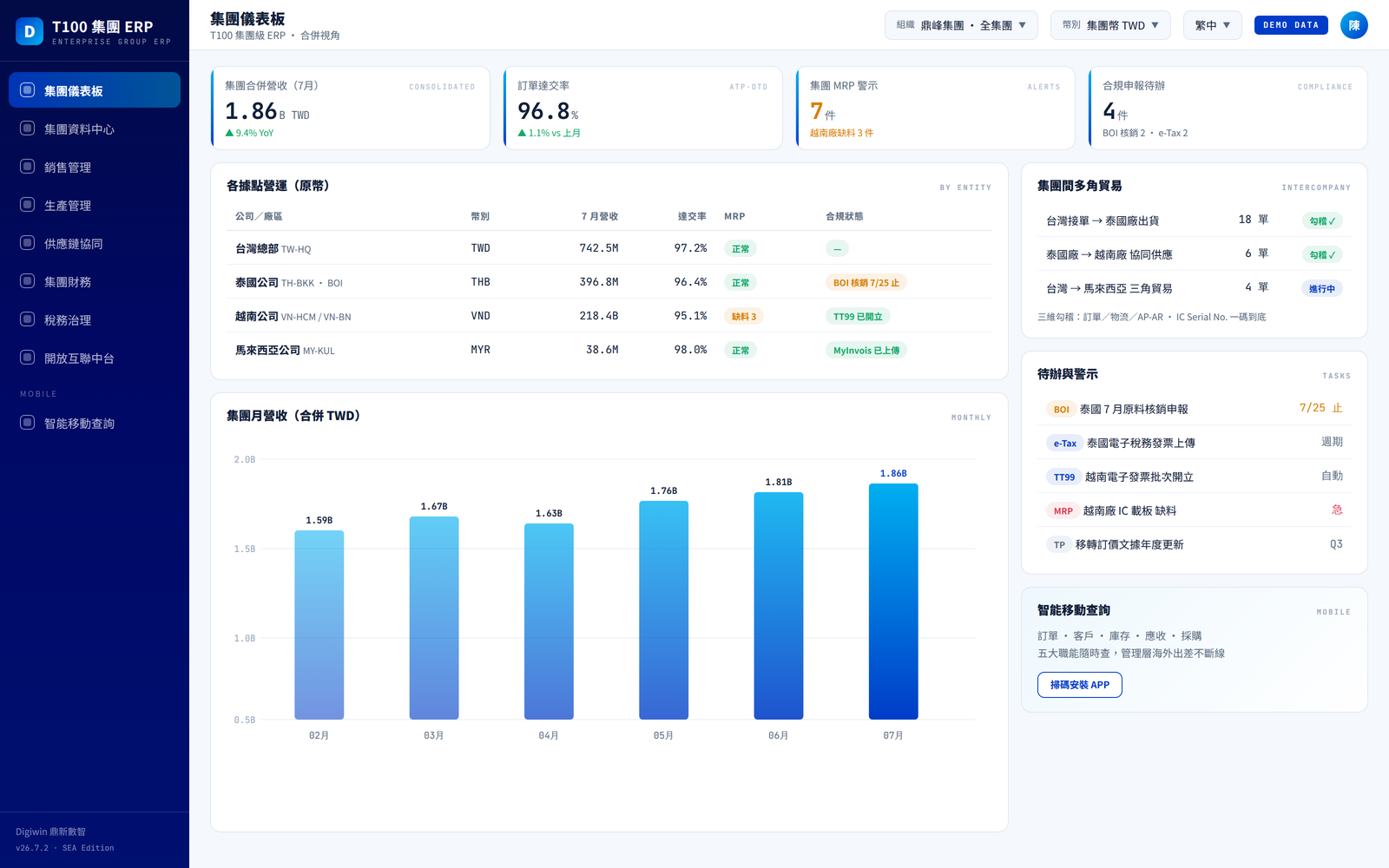
Once a Vietnam plant, a Thailand plant and a Malaysia site are added beyond Taiwan headquarters, orders, production, finance and filing end up scattered across different systems and Excel — T100 targets exactly the three structural pain points most common to multinational manufacturing groups.
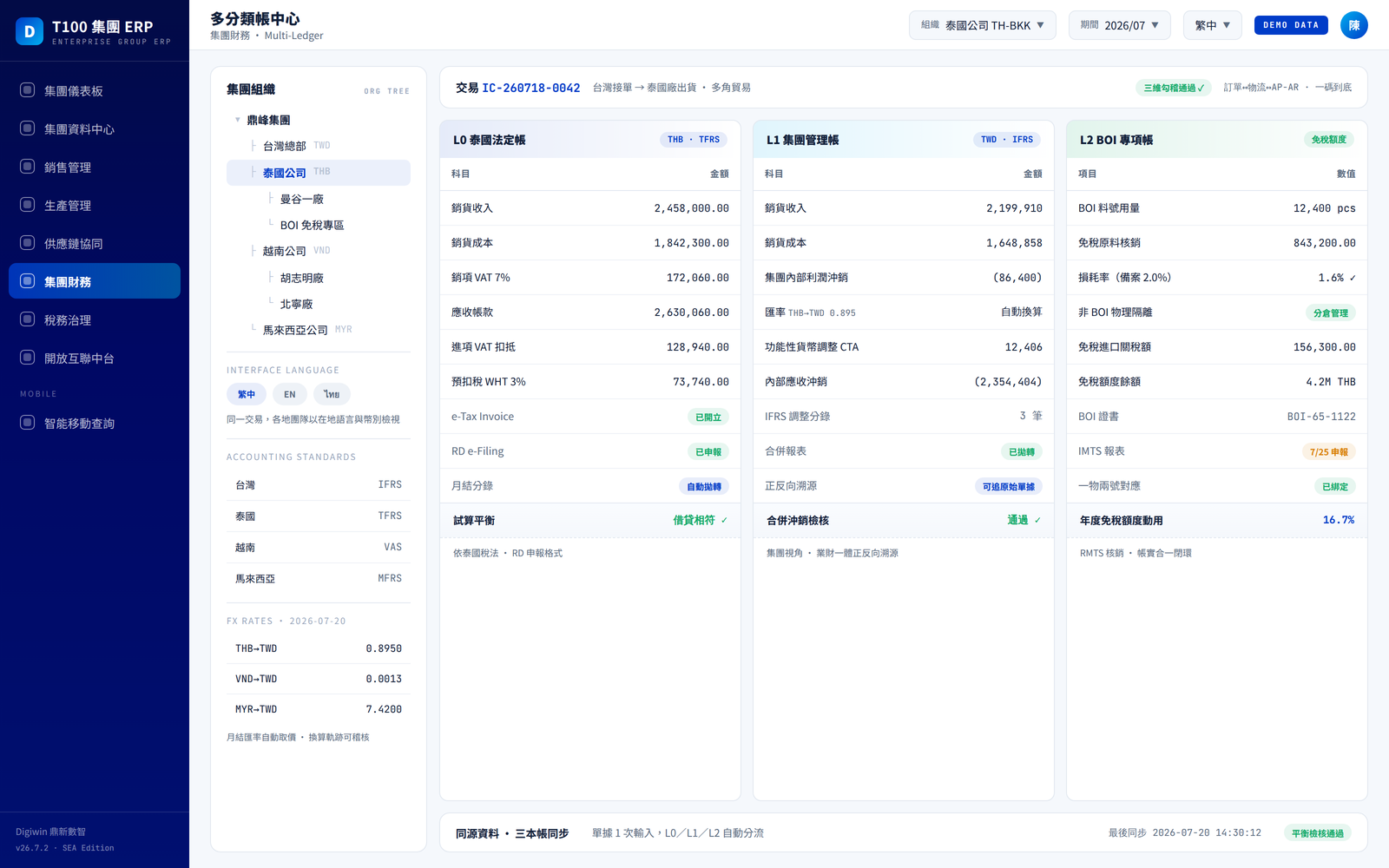
The group uses IFRS, the Gregorian calendar and the parent company's currency, while the local statutory book follows local standards, local currency and even the Buddhist calendar; a single document is recorded separately in each place, month-end relies on manual adjustments, the more you adjust the less you trust the numbers, and it only gets harder to prove yourself once auditors arrive.
Triangular trade and intra-group collaborative production span multiple legal entities: orders, shipments and accounts receivable/payable sit in different systems, related-party transaction prices don't line up, cross-department reconciliation and tracing rely on manual hand-offs, and every break point is a risk point.
Behind BOI and other tax-exempt privileges lie strict requirements for part numbers, BOM (bill of materials) and yield-loss reporting; if reconciliation is managed with Excel ledgers, discrepancies between the records and physical stock can't be traced, and it's often not until an audit arrives that you discover the internal books and the official books stopped matching long ago.
The value of a group-level ERP lies not in having more features, but in the depth of its cross-border compliance. T100 builds multi-book accounting, statutory filing, e-invoicing and multi-language/multi-currency/multi-plant support into the core of the system, forming a closed loop with Digiwin's Southeast Asia local-compliance knowledge base.
Enter a document once and it is automatically split into the local statutory book (local standards / local currency), the group book (IFRS / parent-company currency) and special-purpose books (such as Thailand BOI stock-in/consumption/balance and P&L segregation); all three books share a single source and stay consistent, ending manual month-end adjustments.
Each country's filing requirements are built in as system operations: Vietnam TT99 statutory reports, Thailand BOI-mandated e-filing files and RMTS reconciliation reports, and Malaysia SST filing — the system produces format-compliant filing files so filings are well-grounded and an audit trail is preserved.
Vietnam e-invoices, Thailand e-Tax Invoice (ETDA Std 3-2560, filed by the 15th of the following month and retained for 5–7 years) and Malaysia MyInvois are among the e-invoicing mandates coming into force one after another; with localization modules, T100 produces e-invoice files in each country's format to support filing.
A single system switches among 5 languages including Chinese, English, Vietnamese and Thai, with multi-country accounting standards and tax templates, rapid multi-entity setup and intra-group multi-party trade built in — expatriate managers and local staff each work in their own language on the same set of books.
From group governance and the production supply chain to finance, tax and open integration, T100's modular architecture supports the day-to-day operations and long-term expansion of multinational manufacturing groups.
Architect global operations quickly from a group perspective; multi-entity setup and changes are completed fast, so new southbound sites don't have to be built from scratch.
Planning capability from demand to delivery date is a T100 strength: group MRP (material requirements planning) connects production and sales across plants, so delivery commitments and rush orders are all grounded in data.
Unified business and finance with forward and backward tracing lets every financial figure be traced back to its source document; when facing transfer-pricing and tax-exemption reconciliation audits, the evidence chain is complete.
The open integration middle platform exchanges data with PLM, MES, BPM, WMS and other systems via Web Service; mobile queries let management stay on top of things anytime, even overseas.
Southbound deployment check-up: take stock of your multi-country accounting and filing needs in one passAnswered by a local consulting team with 20+ years in Southeast Asia
Request an AssessmentRepresentative cases unifying multi-country, multi-plant management with T100.
T100 group management with BPM e-approval takes cross-border processes fully paperless.
Digiwin ERP unified part numbers and accounting across the US, Taiwan, China and Indonesia, making triangular trade traceable.
The two serve different but complementary roles: T100 is the group-level ERP governance foundation, solving the structural problems of multi-entity, multi-book operations, cross-border compliance and unified business and finance; AiGP is an AI enablement platform that layers intelligent applications on top of existing systems to amplify workforce productivity. Digiwin's recommended path is “upgrade first, then re-architect” — first use T100 to solidify the group's data foundation, then use AiGP to gradually expand AI use cases. For most multinational groups, the answer isn't either/or, but a matter of sequence.
The timeline depends on the number of entities, the module scope and data readiness, and typically follows a phased go-live: first complete inventory and the financial foundation at core sites, then gradually extend to production, supply chain and cross-border multi-entity operations. Digiwin shortens the build phase with industry-specific templates and multi-country accounting-standard samples; the actual schedule is best assessed by a consultant based on your group's current situation — request an assessment to get a deployment roadmap tailored to you.
Yes. Through its open integration middle platform, T100 exchanges data with PLM, MES, BPM, WMS and other systems via Web Service, so existing system investments are preserved. In practice, one connector manufacturing group used T100 as the core to link 7 product lines, connect 107 processes and build 49 system interfaces, achieving unified integration. The scope and approach of integration can be planned together with a consultant during the assessment, based on your current systems.
The system uses dual part-numbers (one item, two numbers) to segregate tax-exempt and taxable materials; combined with BOI-specific BOM (bill of materials) and material stock-in/consumption/balance tracking, it produces system reports that map to RMTS reconciliation. Thailand operations are delivered by the local Digiwin (Thailand) team, and the system can produce files in the format required for BOI e-filing, which the company uploads and files through the government-designated platform. See the Thailand BOI Compliance Page for the full mechanism.
Whether you're evaluating a southbound plant, have just completed an overseas rollout, or are being overwhelmed by multi-country accounting and filing, the Digiwin Southeast Asia team can help you take stock of where you stand and plan a group-system blueprint that gets it right the first time.
Digiwin · 44+ years in manufacturing · 20+ years serving Southeast Asia · Vietnam · Thailand · Malaysia · Indonesia · trusted by 500+ customers